Why Lithium Battery Systems Matter for Off-Grid Camping
Understanding lithium battery systems for off-grid camping. 300Ah vs 100Ah, solar charging, appliance power draw, and how it affects your trip comfort.

Dorian Menard
Founder & Owner
Power is the single variable that separates a comfortable off-grid camping trip from a frustrating one. You know the feeling when the fridge warms up, the lights dim, and the camp coffee routine grinds to a halt.
We have spent years fitting and testing battery systems across our Perth fleet to solve exactly this. Your power setup decides how far from the grid you can sit before things start going flat.
Here is why lithium has become the standard we fit for Western Australia.
Lead-Acid vs Lithium: The Efficiency Gap
Traditional lead-acid batteries, including AGM and deep cycle types, served the 4WD community well for decades. They are heavy, inefficient, and slow to charge.
These days we rarely fit them, and the reason is the “usable capacity” problem. A standard 100Ah AGM battery really only gives you 50Ah before the voltage drops too low to run appliances.
Lead-acid also suffers from Peukert’s Law: the faster you drain it, the less total energy you actually get.
Lithium iron phosphate (LiFePO4) changes the equation entirely. A 100Ah lithium battery delivers 80 to 90Ah of usable power and holds a steady voltage right until it is empty.
The weight difference jumps out during every install. A 100Ah AGM weighs roughly 30kg. The equivalent lithium unit weighs just 12kg to 14kg.
Comparison of 100Ah Batteries:
| Feature | AGM (Lead-Acid) | LiFePO4 (Lithium) |
|---|---|---|
| Usable Capacity | ~50Ah (50%) | ~90Ah (90%) |
| Weight | 30kg | 13kg |
| Cycle Life | 500-800 cycles | 2,000-5,000 cycles |
| Voltage Stability | Drops steadily | Constant until empty |
| Charging Speed | Slow absorption phase | Fast bulk charging |
For WA camping, where corrugated gravel rattles heavy gear relentlessly, shedding 15kg per battery saves wear on your vehicle’s suspension.
Defining Amp-Hours: 100Ah vs 200Ah vs 300Ah
Battery capacity is measured in amp-hours (Ah). Think of it as the fuel tank size for your electrical system. The number on the box only means something once you turn it into real-world runtime.
These are the average draws we use when sizing a client’s system:
| Appliance | Average Hourly Draw | Daily Estimate (24h) |
|---|---|---|
| 40L Compressor Fridge | 1.5 - 2.5 Amps | 30 - 45 Ah |
| LED Camp Lights (x2) | 0.5 - 1 Amp | 3 - 5 Ah |
| Phone Charging | 1 - 2 Amps (total) | 5 - 10 Ah |
| Laptop Charging | 3 - 5 Amps | 15 - 20 Ah |
| Starlink (Gen 2/3) | 4 - 6 Amps | 40 - 60 Ah (10 hrs use) |
| 12V Oven | 10 - 15 Amps | 10 - 15 Ah (1 hr use) |
100Ah Lithium (The Weekender)
A 100Ah lithium battery gives you roughly 80Ah to 90Ah of real power. That comfortably runs a fridge, charges phones, and powers lights for about 48 hours with no solar input at all.
This size suits travellers who move camp daily. The alternator tops the battery back up while you drive, so it holds up fine on high-mobility trips.
200Ah Lithium (The Standard)
This is the sweet spot for most Western Australian trips. You get around 180Ah of usable power, enough to sit stationary for three to four days in moderate weather without starting the car.
From what we see across the fleet, 200Ah is the minimum if you plan to run an inverter for laptops or camera gear. It also buys you a buffer on cloudy days when solar input drops off.
300Ah Lithium (The Remote Office)
A 300Ah system gives you serious independence for long-term travel. This is the one you want if you run high-draw appliances like a portable induction cooktop, a 12V travel oven, or a Starlink unit for remote work.
We fit this capacity in our OFFGRID Wanderer vehicles so clients can work from somewhere like Cape Le Grand National Park without sweating a blackout. Run a mobile office eight hours a day and still keep the beers cold.
Solar Charging: Getting the Most from WA’s Sun
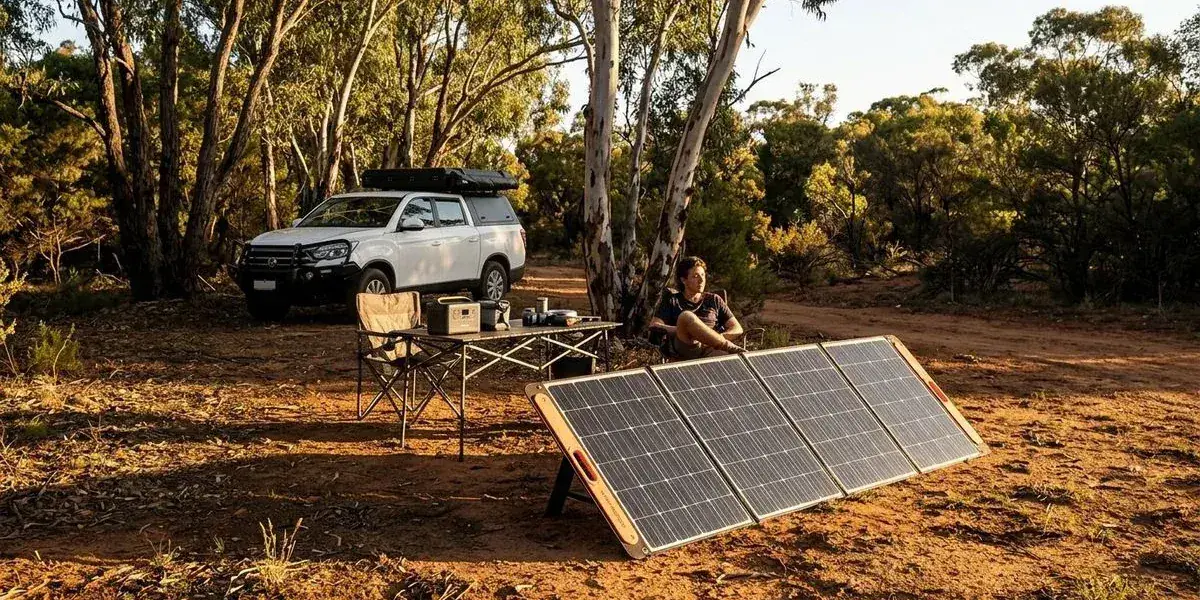
A battery bank is only as good as your ability to refill it. Western Australia has some of the highest solar irradiance on earth, often more than 5 peak sun hours a day up north.
A good 200W panel will typically push 10 to 14 amps through the middle of the day. Over a full day that works out to roughly 60Ah to 80Ah back in the bank.
Fixed Roof-Mounted Panels
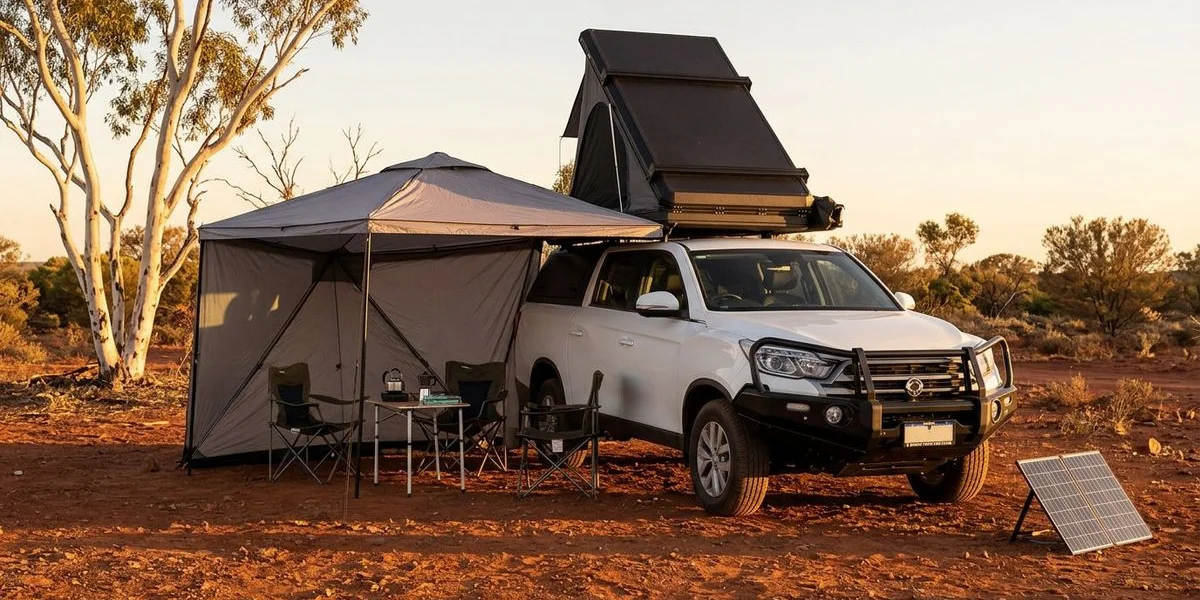
Fixed panels offer a “set and forget” solution that charges your auxiliary battery whenever the vehicle is outside. They are theft-proof, require zero setup time, and work while you are driving.
The main drawback is heat. To get the best charge, you must park in the sun, which heats up your fridge and makes the battery work harder.
Portable Solar Blankets
Portable panels allow you to park the vehicle in the shade while positioning the panel in the sun. This can increase your overall system efficiency by keeping the fridge cooler.
In our experience portable panels pull 15% to 20% more power than fixed ones, simply because you can angle them straight at the sun rather than leaving them flat on a roof. The trade-off is the daily faff of setting them up and pegging them down against wind or theft.
Running both is the ideal. A fixed panel handles the base load, and a portable blanket adds a boost on the days you stay put.
Real-World Power Scenarios
Scenario 1: The Lancelin Weekend
You are heading two hours north of Perth for two nights of fishing. The drive charges the battery fully before arrival.
The Reality: Your 100Ah lithium battery runs the fridge and lights effortlessly. You likely won’t even need to deploy a solar blanket.
Scenario 2: The Coral Coast Explorer
You are driving from Perth to Exmouth over ten days, stopping at coastal camps like Cliff Head and Warroora Station.
The Reality: A 200Ah system combined with a 200W fixed solar panel is ideal here. The driving between campsites (alternator charge) combined with the strong coastal sun keeps the battery near 100% capacity daily.
Scenario 3: Remote Work from the Pilbara
You are camped at a gorge in Karijini National Park for five days. You need to run Starlink for six hours a day and charge a laptop.
The Reality: The Starlink unit draws about 50 watts continuously. Over six hours, that consumes roughly 25Ah to 30Ah. Add the fridge and lights, and your daily consumption hits 80Ah. A 300Ah system with 400W of solar input is necessary to keep up with this demand without running the engine.
The Role of the DC-DC Charger
Driving is the most consistent way to charge your batteries. A modern DC-DC charger acts as the brain between your vehicle’s alternator and your auxiliary lithium battery.
We use chargers that isolate the starter battery so you never get stranded with a flat crank. They also boost the voltage so the lithium battery actually reaches 100%, which a standard alternator can’t do on its own.
A quality 40A DC-DC charger will replenish a 100Ah battery from flat to full in about 2.5 hours of driving.
Why Monitoring is Non-Negotiable
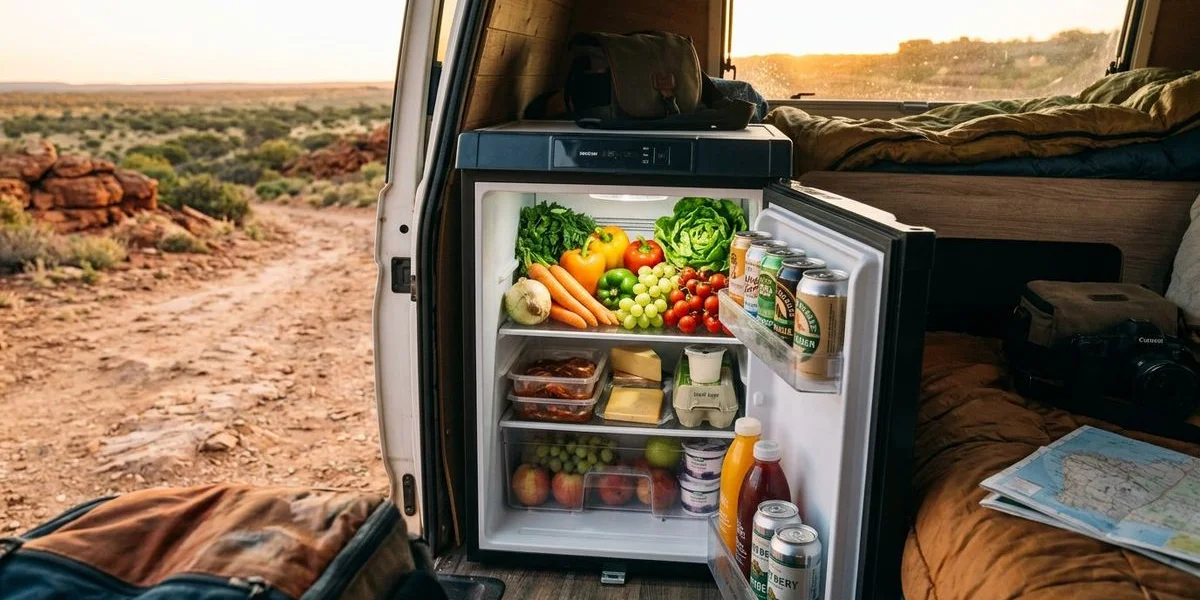
A battery system without a monitor is a guessing game, and the guess usually ends in warm food. You can’t read a lithium battery’s charge by voltage alone, because the voltage stays high right up until it falls off a cliff.
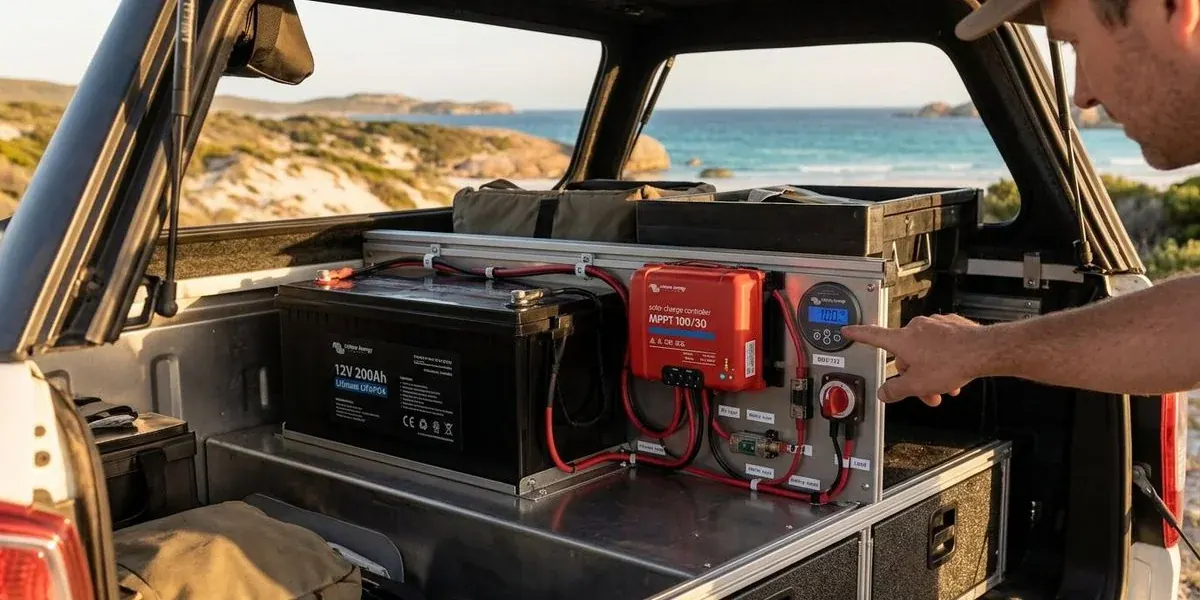
Every vehicle we run has a shunt-based monitor fitted. It counts every amp going in or out of the battery and gives you a percentage reading, much like the one on your phone.
Knowing you have “30% remaining” allows you to make decisions. You might choose to turn off the inverter or deploy the extra solar blanket to get through the night.
The Verdict
The right system depends entirely on your travel style.
- 100Ah: Perfect for weekenders and high-mobility travellers.
- 200Ah: The reliability standard for extended touring.
- 300Ah: The mandatory baseline for digital nomads and remote workers.
Our fleet comes pre-fitted with these lithium systems because we know they survive the corrugations out here. You don’t need to be an electrician to travel off-grid. You just need the right gear behind you.
Planning a build, or looking to rent a vehicle that can handle the remote coast? Get in touch. We’re happy to help you work out the right setup for your trip.
Ready to Start Your Adventure?
Premium 4WD campers from $160/day. Depot pickup in Cloverdale, 5 minutes from Perth Airport.
Check Availability