What to Look for When Hiring a 4WD Camper in Perth
Key factors to compare when hiring a 4WD camper in Perth: vehicle condition, included gear, insurance, km allowance, and payment terms explained simply.

Dorian Menard
Founder & Owner
Hiring a 4WD camper in Perth is one of the best ways to see Western Australia, but the companies renting them are not all the same. You know the feeling: the “rugged expedition vehicle” in the photos turns out to be a tired work ute with a cheap tent bolted to the roof. We have been doing this for over twelve years, and the gap between a dream trip and a mechanical headache usually comes down to a handful of things people forget to check.
This guide walks through those checks: vehicle condition, the costs that hide in the rental agreement, and the insurance clauses that catch travellers out.
Vehicle Age and Condition
This is the factor that matters most, and the one most people skip past. A brand-new vehicle photographs well, but a well-maintained older model is often the more reliable choice in the bush. The sweet spot is a vehicle two to four years old with a service history you can actually see, and it is the benchmark for every 4WD camper in Perth we rent out.
Ask straight out about the model year and any suspension upgrades. A standard Toyota Hilux will get you there, but one fitted with heavy-duty suspension like Old Man Emu or ARB handles the corrugated gravel into Karijini in a different league.
Push past the oil-change entries when you look at the service history. Ask whether the wheel bearings and suspension bushes have been checked lately, because WA’s corrugated tracks chew through those parts far faster than highway driving ever will. No maintenance log, or no straight answer? Walk away.
Look hard at the tyres at pickup. WA roads, especially the unsealed stretches north of Geraldton or east of Hyden, will shred worn rubber. You want quality all-terrain tyres like BFGoodrich or Cooper with at least 60% tread left, and a spare that matches them, not a bald “get-home” tyre shoved under the tray.
What’s Included in the Hire
There is a huge gap between a bare 4WD hire and a fully kitted camper. Plenty of budget operators hand you what is basically an empty shell, then you burn your first day in Perth racing around buying gear at full retail.
A proper camper setup comes with reliable, brand-name kit. Look for a 12V dual-battery system with a DC-DC charger keeping the fridge cold, not a cool box wired into a cigarette lighter.
Use this checklist to compare quotes properly:
| Item | Standard Hire Inclusion | Premium Hire Expectation |
|---|---|---|
| Refrigeration | Cheap electric cooler or Esky | 40L+ Compressor Fridge (e.g., Engel, Dometic) |
| Shelter | Basic ground tent | Quality Rooftop Tent or Swag (e.g., Darche, 23Zero) |
| Power | Vehicle starter battery only | Dual battery system with solar input |
| Cooking | Single burner butane stove | Twin burner gas stove with 2kg-4kg gas bottle |
| Water | 10L-20L plastic jerry can | 40L-60L onboard water tank with pump |
| Recovery | Often extra cost | Snatch strap, shackles, shovel, tyre gauge, compressor |
Watch for operators charging extra for things that should already be in the price. We regularly see competitors add $25 a day for a fridge and $15 for an awning. Those “small” daily fees can tack $500 onto a two-week trip, and suddenly the cheap quote costs more than the all-inclusive one.
Kilometre Allowance
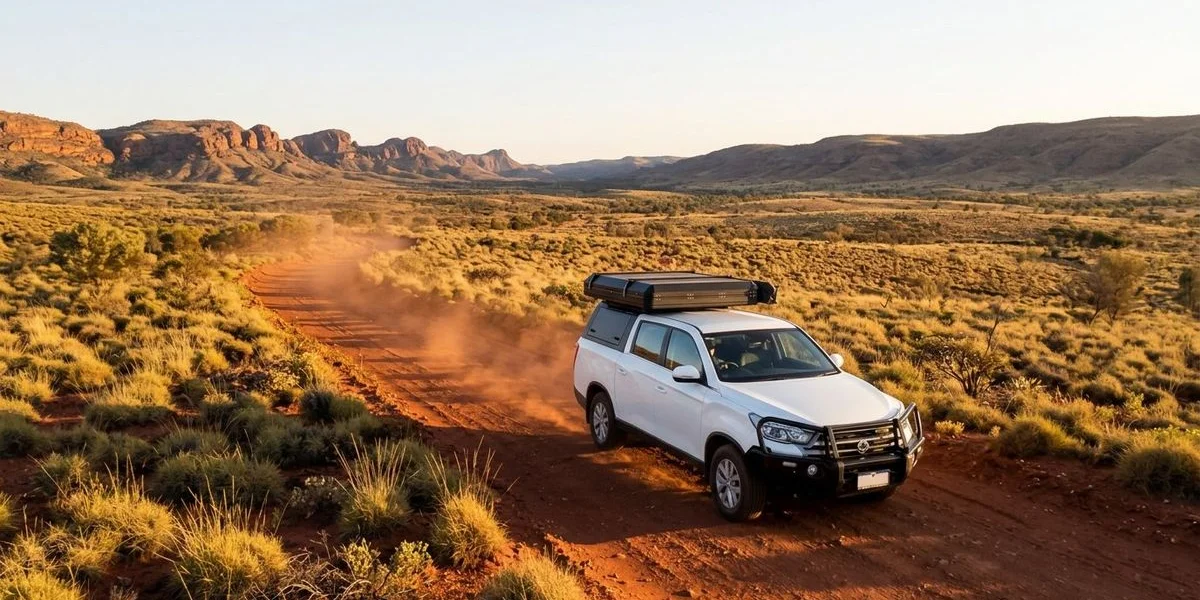
This one catches more people out than anything else on the list. WA is vast, and the distances between the big sights are easy to underestimate. Perth to Exmouth alone is roughly 1,250 kilometres one way, before you add a single side trip to Coral Bay or Shark Bay.
Plenty of companies cap you at 200 or 300 kilometres a day. A Perth to Exmouth return with a Karijini loop on the way home clocks close to 5,000 kilometres without trying. Cap that at 300km/day across 14 days and you have 4,200km to play with, so that run leaves you 800 kilometres over. At the standard $0.30 per kilometre, that is an extra $240 you didn’t budget for.
Map your whole route in Google Maps first, then add 20% for the detours you will inevitably make. If the number blows past the cap, sort out an unlimited-kilometre package before you sign. Paying for the unlimited pack up front almost always beats paying the excess rate at the end.
Insurance and Excess
Every hire company offers insurance. The detail is where it gets you. Standard travel insurance often excludes “4WD rental excess,” which leaves you on the hook for thousands if something goes wrong.
Find the “Single Vehicle Rollover” clause and read it. In WA, plenty of insurers won’t cover you if you roll the vehicle without hitting another car, and that is one of the more common ways to come unstuck on gravel, thanks to soft edges and animals on the road. If it is excluded, you can be liable for the full replacement cost of the vehicle, which can top $80,000.
Key questions to ask:
- What is the standard liability? This is usually between $5,000 and $8,000.
- Does the excess reduction cover animal strikes? Kangaroos are a major hazard, especially at dusk.
- Is “overhead and underbody” damage covered? Most standard policies exclude damage to the roof (from trees) and the undercarriage (from rocks).
- Are there night driving restrictions? Many contracts void your insurance if you drive outside gazetted town boundaries between sunset and sunrise.
- Which unsealed roads are actually approved? Get the specific roads on your route signed off in writing before you leave. Most operators, us included, require pre-approval for unsealed sections and exclude the hard tracks outright.
Read the Product Disclosure Statement (PDS) properly before you sign anything. For most trips, paying the extra daily fee (often $40-$60) to drop your liability to $0 or $500 is money well spent.
Bond and Payment Terms
The bond, or security deposit, swings wildly from one company to the next. Some operators want up to $8,000 if you skip their insurance reduction package. With us there is no cash bond: insurance, excess and roadside assistance run through Camplify under Camplify’s standard rules, and Camplify explains the excess options on its accident excess page.
If you are comparing operators that do take a bond, these questions are worth asking:
- Is it a pre-authorisation or a charge? A pre-authorisation just freezes the funds. An actual charge takes the money from your account, and refunding it can take up to 21 days after your trip.
- Do you accept debit cards? Most companies require a credit card for the bond. If you use a debit card, the funds are physically removed from your bank account, leaving you with less spending money for your holiday.
- What are the cleaning fees? Ask for a written list of cleaning expectations. Returning a vehicle with red dust in the door jambs is normal; returning it with a mud-caked interior usually attracts a $200+ professional cleaning fee.
Pickup and Return Process
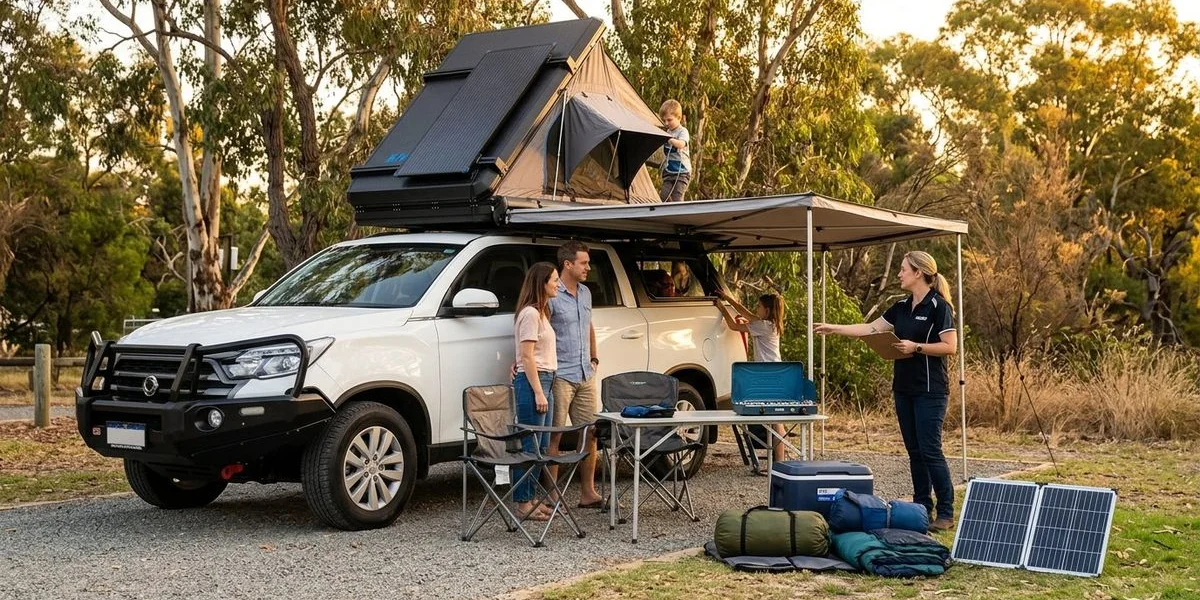
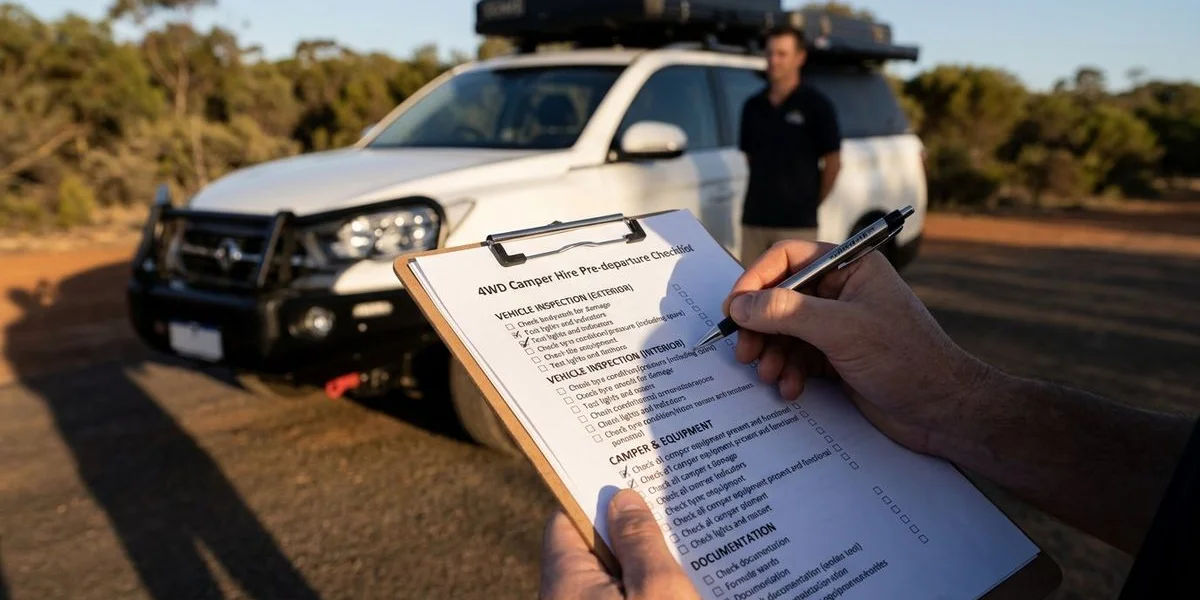
A proper pickup protects both sides. Don’t sign the paper and drive off. Spend 30 minutes walking the vehicle with the staff.
Record a slow walk-around video on your phone while you do it. Zoom in on the windscreen for existing chips, the lower panels for stone marks, and the tyres. That clip is your best evidence if a dispute comes up later.
At return, inspect the vehicle together. Damaged a tyre or cracked a windscreen? Say so. Most reputable companies are fair about genuine wear and tear, but hiding damage is how people end up with the maximum charge.
After-Hours Support
WA is remote in a way that surprises first-timers. Break down between Carnarvon and Exmouth and you could be 200 kilometres from the nearest mechanic. So you want to know your hire company has thought this through. If this is your first big trip, start with our overlanding for beginners guide.
The good operators run 24/7 phone support and keep a network of mechanics across regional towns. Ask whether they supply a satellite phone or fit Starlink to their vehicles, because mobile reception drops out for huge stretches of the North West Coastal Highway.
Download offline maps before you leave Perth, HEMA Maps or Gaia GPS. They work with no phone signal and let you give the support team your exact position if things go sideways.
The Bottom Line
The cheapest hire is rarely the best value. A low daily rate usually hides pricey add-ons, a high excess, and gear that lets you down at the worst possible moment.
Look at the total cost of the package, fridge, bedding and insurance reduction included, and pick a company that is upfront about how it maintains its vehicles and where its insurance stops. A reliable vehicle and support you can actually reach are what let you get on with enjoying Western Australia instead of worrying about the camper.
Ready to Start Your Adventure?
Premium 4WD campers from $160/day. Depot pickup in Cloverdale, 5 minutes from Perth Airport.
Check Availability