10 Essential Driving Tips for WA Outback Roads
Stay safe on Western Australian outback roads. Tips on fatigue management, wildlife, fuel planning, unsealed roads, and emergency preparation.

Dorian Menard
Founder & Owner
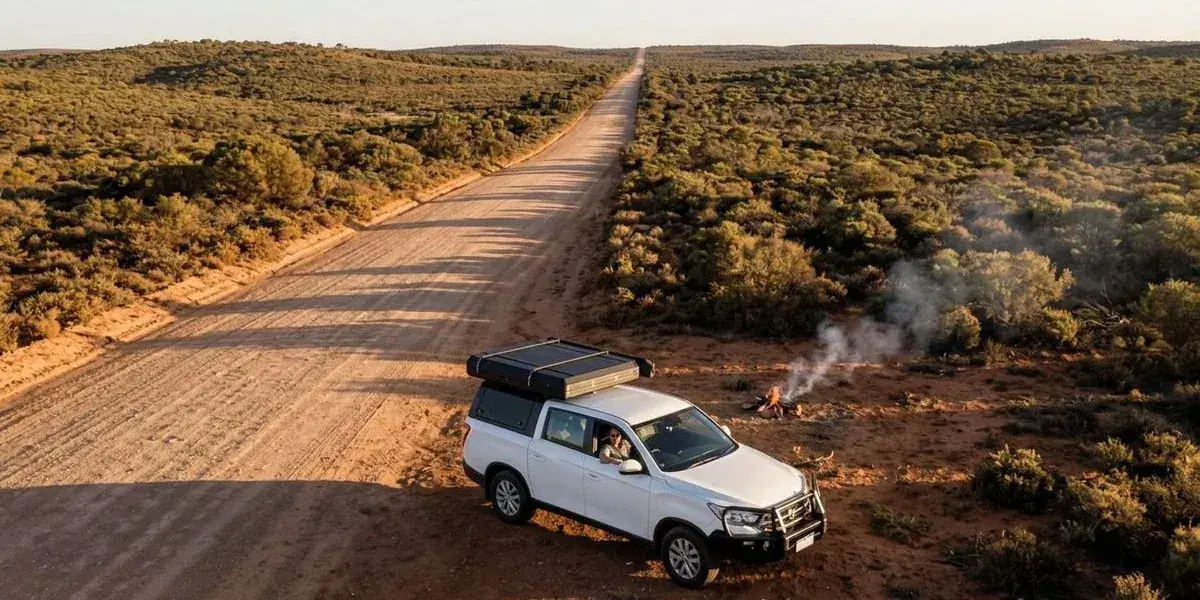
Western Australia has some of the best driving routes anywhere, and some of the most remote, unforgiving roads you’ll ever point a vehicle down. The distances between towns are vast, the terrain is harsh, and conditions change fast. None of that should put you off. It just means you need to turn up prepared.
Heading north along the Coral Coast, cutting inland to Karijini, or working your way through the South West, these ten tips apply either way. We’ve sent thousands of renters out onto these tracks over the years, and the advice below is what keeps the vehicle in one piece and lets you enjoy the drive instead of white-knuckling it the whole way.
1. Plan Your Fuel Stops Carefully
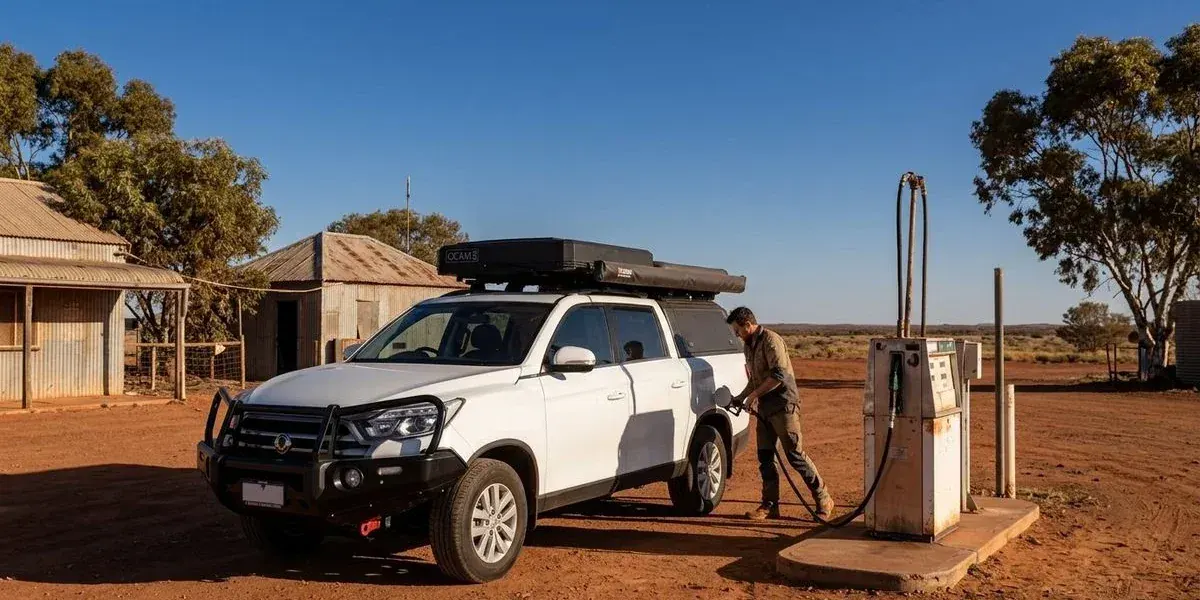
This is tip number one for a reason. Running out of fuel out here isn’t an inconvenience, it’s a genuine safety risk. The gaps between fuel stations can be enormous: the stretch between Sandfire Roadhouse and Roebuck Plains Roadhouse on the Great Northern Highway is roughly 288 kilometres.
Stretches of the North West Coastal Highway and the inland route to Karijini have gaps exceeding 300 kilometres depending on roadhouse operating hours.
The rule: never pass a fuel station with less than half a tank.
It doesn’t matter if it’s expensive, if the servo looks dodgy, or if you reckon you can make the next one. Fill up whenever you can. Our KGM campers carry a solid fuel range, but throwing a 20-litre jerry can in the back on remote routes is just standard practice.
Pro Tip: Buy a “jiggle siphon” for your jerry cans so you don’t have to lift a heavy 20kg container and risk spilling fuel in the dust.
Use the FuelWatch WA website to check prices and the Main Roads WA app to confirm which roadhouses are open before you set off.
2. Drive to Conditions on Unsealed Roads
Corrugated gravel roads are a defining feature of outback travel in WA, and they require a different driving approach than sealed bitumen.
A major study found that stopping distances on loose gravel can be 54% longer than on sealed roads at highway speeds.
The temptation on corrugations is to speed up to find the “harmonic” speed where the vehicle feels smoother.
This is a dangerous myth because “floating” over corrugations means your tyres are losing contact with the road surface, dramatically reducing your control.
Recommended speeds:
- Well-graded gravel roads: 60-80 km/h
- Corrugated roads: 40-60 km/h
- Rocky or rutted tracks: 20-40 km/h
- Sandy sections: 15-30 km/h (often in low range)
Slow down for corners, crests, and dips.
You can’t see what’s around a blind bend on a single-lane gravel road, and oncoming road trains aren’t going to stop for you.
3. Watch for Wildlife at Dawn and Dusk
Kangaroos, emus, cattle, and camels are all common on WA roads, and they have zero road sense.
Kangaroos are most active at dawn and dusk, which unfortunately coincides with the low sun angle that makes them hardest to spot.
Specific Hazard: Be wary of Wedge-tailed Eagles feeding on roadkill.
These massive birds can weigh over 5kg and need a long “runway” to take off, meaning they often can’t fly out of your way in time if you approach at speed.
Best practice: avoid driving in the hour after sunrise and the hour before sunset, especially on open roads through pastoral country.
If you must drive during these times, reduce your speed significantly and keep your eyes scanning both sides of the road.
If an animal is on the road, slow down and let it move.
Do not swerve.
Hitting a kangaroo is bad, but rolling a 4WD trying to avoid one is far worse.
4. Manage Fatigue with Regular Stops
Fatigue is a silent killer on regional roads. Statistics from 2024 show 61% of road fatalities in WA happened in regional areas, with fatigue suspected as a factor in nearly one-fifth of crashes. The long, straight outback roads are the worst for it, because the monotony is genuinely hypnotic.
You can drive for hours without a turn, a town, or a change in scenery, and your concentration deteriorates without you realising it.
WA’s Driver Reviver stops are located at key points along major highways.
Use them.
Stop every two hours, get out of the vehicle, have a coffee, and walk around for ten minutes.
Swap drivers if you have someone else licenced.
If you’re feeling drowsy, pull over and have a 15-minute power nap.
It is far better to arrive late than not arrive at all.
Plan your driving days so you’re not covering more than 400-500 kilometres in a single stretch.
The outback isn’t a highway you rush through.
5. Adjust Tyre Pressure for Different Surfaces
Tyre pressure is one of the most important aspects of outback driving.
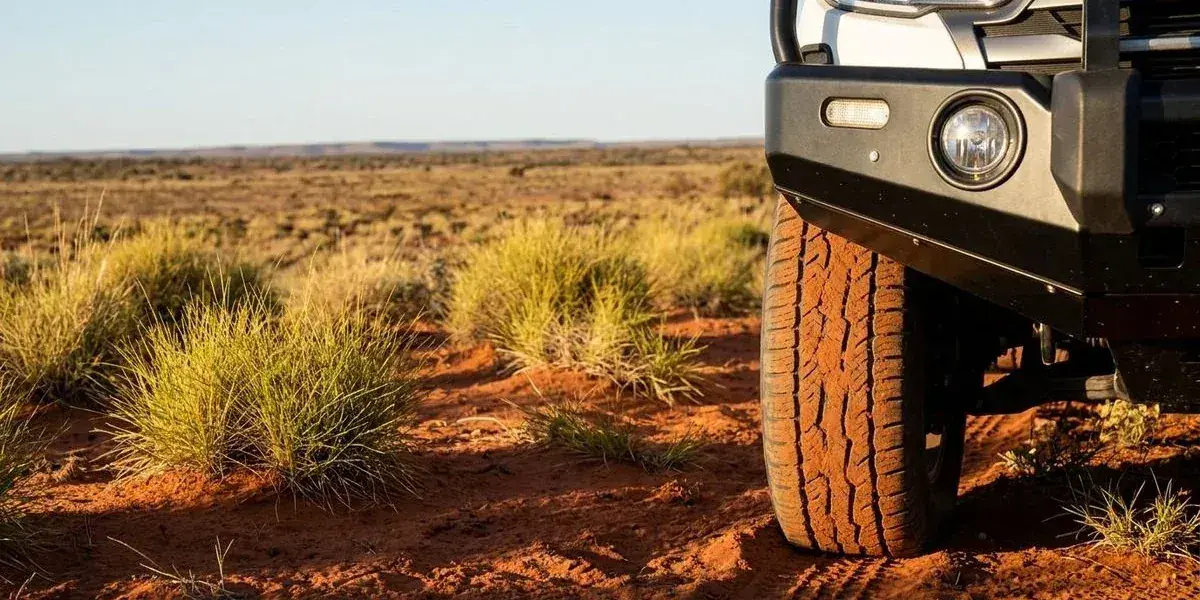
The pressures that work on sealed roads are too high for unsealed surfaces, leading to punctures and suspension damage.
General guidelines:
| Surface Type | Recommended Pressure |
|---|---|
| Sealed Highway | Standard (32-36 psi) |
| Gravel / Dirt | Drop 4-6 psi (approx. 26-28 psi) |
| Sand | 16-22 psi |
| Rocky Tracks | 26-30 psi |
The 4 PSI Rule: Check your tyre pressures cold, then check them again after an hour of driving.
If the pressure has risen by more than 4 psi due to heat, your starting pressure was too low for the load and speed, and you need to inflate slightly to reduce casing flex.
Always carry a reliable tyre pressure gauge and a 12V air compressor to reinflate when you return to sealed roads.
Driving on deflated tyres at highway speed will generate excessive heat and destroy the sidewalls.
Our campers come equipped with compressors, but knowing how to use them properly makes all the difference.
6. Carry Plenty of Water
The WA outback gets extraordinarily hot, and dehydration is a serious risk if you break down.
The standard recommendation is a minimum of 10 litres of drinking water per person for emergency use, separate from your daily washing water.
We recommend carrying electrolyte tablets (like Hydrolyte) in your glovebox, as water alone sometimes isn’t enough to treat severe heat exhaustion.
Store water in sturdy, food-grade HDPE containers (usually blue), not flimsy plastic supermarket bottles that can split due to vibration.
Keep some water in the cabin rather than all in the tray.
If the vehicle becomes immobilised or you are injured, you want water within arm’s reach.
Our 4WD campers in Perth have water storage built into the setup, but supplementing with additional containers for truly remote routes is always a good idea.
7. Tell Someone Your Itinerary
Before heading into remote areas, share your planned route, expected stops, and estimated arrival times with someone who isn’t travelling with you.
This could be a family member, a friend, or even the staff at your last roadhouse stop.
If something goes wrong and you don’t check in when expected, that person can alert authorities and provide them with a starting point for a search.
Helpful Contact: Save the WA Police non-emergency number (131 444) in your phone for reporting road hazards that aren’t immediate life-threatening emergencies.
Pair this with a satellite communicator (like a Garmin inReach or a Starlink connection) so you can send check-in messages from areas without mobile coverage.
You can also register your trip and beacon details with AMSA (Australian Maritime Safety Authority) online before you leave.
8. Check Road Conditions Before You Go
Road conditions in WA change rapidly, especially during and after the wet season.
A road that was perfectly passable last week can be closed due to flooding, washouts, or cyclone damage today.
Critical Warning: As of late 2025, the penalty for driving on a closed road in WA has increased to $10,000.
Main Roads WA maintains a real-time road conditions website and app that shows closures, restrictions, and conditions for all major and minor roads across the state.
Check it the day before you travel, and again on the morning of departure.
For specific unsealed routes, local Facebook community groups often have the most up-to-date reports from fellow travellers.
Ignoring road closures puts rescue crews at massive risk if they have to retrieve you.
9. Understand Speed Limits on Unsealed Roads
Western Australia has default speed limits that apply when there are no signs posted:
- Built-up areas: 50 km/h
- Outside built-up areas (sealed): 110 km/h
- Outside built-up areas (unsealed): 110 km/h (Legal maximum, NOT a target)
Just because the legal limit is 110 km/h on an unsealed road doesn’t mean you should be doing anywhere near that speed.
Most experienced outback drivers find 80 km/h to be the “sweet spot” on good gravel.
It gives you enough momentum to skip over minor corrugations but keeps your stopping distance within a survivable range.
The legal speed limit and the safe speed are two very different things on outback roads.
Drive to the conditions, not the sign.
10. Pack an Emergency Kit
Hope for the best, prepare for the worst.
Every vehicle heading into the WA outback should carry a properly stocked kit.
Essential items checklist:
- Snake Bite Bandage: Look for “indicator bandages” that show rectangles turning into squares when stretched to the correct tension.
- UHF Radio: Essential for communicating with road trains (usually on Channel 40) to arrange safe overtaking.
- Recovery gear: Snatch strap, rated shackles, shovel, and traction boards.
- Fire extinguisher: Grass fires and vehicle fires happen in extreme heat.
- Spare tyre: Ideally two spares for long unsealed stretches such as the inland run to Karijini.
- Headlamp: Much better than a handheld torch so your hands stay free for repairs.
- Basic tool kit: Spanners, pliers, cable ties, duct tape, and fencing wire (the outback mechanic’s best friend).
Our KGM OFFGRID Wanderer (from $160/day) and Bakkie (from $200/day) campers come equipped with essential recovery gear.
Checking the kit before departure and adding any personal items you might need is always worthwhile.
Before You Head Out
The Western Australian outback rewards people who respect it. None of this is meant to scare you off, it’s meant to get you travelling confidently through some of the best country on earth. Preparation is what turns a trip that could go sideways into the one you talk about for years.
If you’re planning an outback trip from Perth, get in touch to discuss your route.
We’re happy to share specific advice for wherever you’re heading. You collect from our Cloverdale depot, 5 minutes from Perth Airport, and we walk you through the whole setup before you head off.
Ready to Start Your Adventure?
Premium 4WD campers from $160/day. Depot pickup in Cloverdale, 5 minutes from Perth Airport.
Check Availability