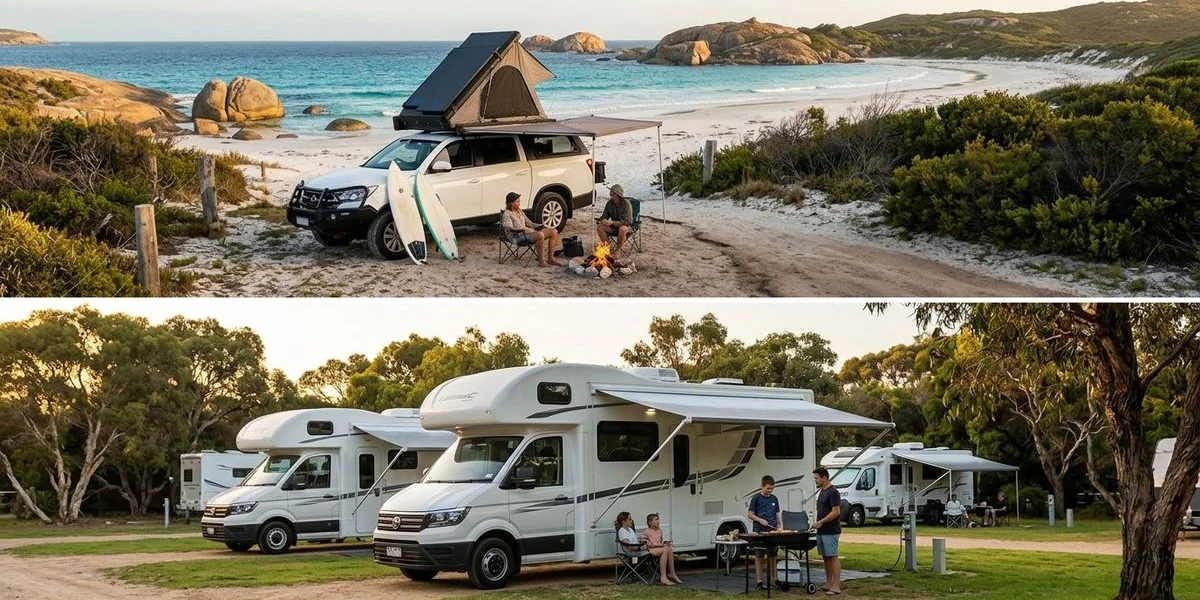
Dual-Cab Ute Camper vs Motorhome: Which Suits Your WA Trip?
Comparing dual-cab 4WD campers and motorhomes for Western Australia road trips. Access, fuel costs, flexibility, and which handles WA roads better.

Dorian Menard
Founder & Owner
Should I hire a motorhome or a 4WD camper? It is one of the first questions people ask me when they start planning a Western Australia road trip.
The honest answer has less to do with comfort than with where you can actually go.
I have spent years driving this state, and both vehicles have their place. But a WA trip is its own beast. The distances are huge, the best spots tend to sit at the end of a corrugated dirt track, and the fuel bill can be a genuine shock if nobody warns you first.
Here is how the two stack up in the real world, so you can match the vehicle to your itinerary.
Access: Where Can You Actually Drive?
For a lot of WA itineraries, this one factor settles the whole argument, and it is where a 4WD camper hire in Perth pulls ahead.
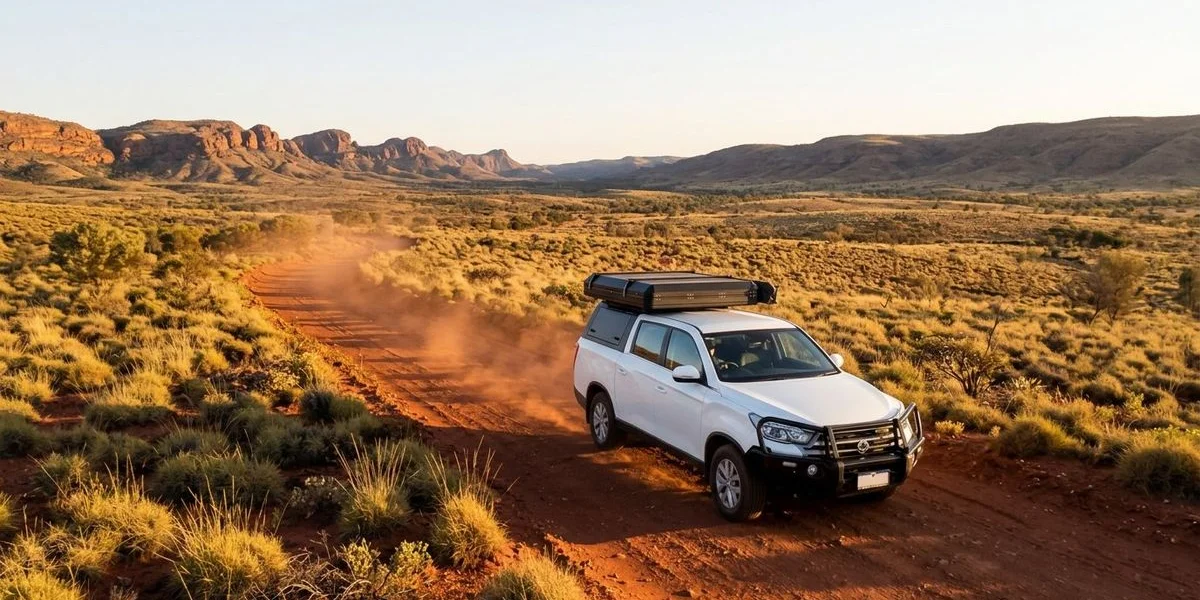
Most rental motorhomes are limited by contract to sealed roads and well-maintained gravel highways. That is fine if you only want the Perth to Adelaide run, or the bitumen north. It also locks you out of a lot of what people come to WA for.
Every season we hear from travellers who missed Karijini National Park’s best gorges, because the roads into Weano and Hancock are often heavily corrugated gravel and their hire vehicle simply was not allowed down them.
Specific Access Restrictions You Must Know:
- Karijini National Park: The gravel roads to the Weano and Hancock gorge car parks corrugate badly through the dry season. High-clearance 4WD is the sensible minimum, and most motorhome contracts rule them out entirely.
- Cape Range National Park: The gravel sections along Yardie Creek Road toward Osprey Bay and the southern bays are fine in a 4WD and off-limits under a lot of motorhome agreements.
- Coral Coast station stays: Working stations between Carnarvon and Exmouth sit at the end of long unsealed access roads. It is the difference between a beachfront camp to yourself and another powered site in town.
A dual-cab 4WD ute camper covers everywhere a motorhome goes, plus the approved unsealed roads it can’t. Worth being straight about the other end of the scale though: hard-core tracks are excluded on hire vehicles generally, ours included, so the Gibb River Road and the Canning Stock Route are not on the menu whichever way you book. Unsealed roads need our pre-approval before you go.
Fuel Economy and Running Costs
WA is big, and diesel gets dearer the further you drive from Perth.
In early 2026 we are seeing diesel in Perth around $1.66 per litre. Remote roadhouses like Nanutarra, or the ones strung along the Nullarbor, are charging upwards of $2.25 per litre. A 60-cent gap sounds trivial until you multiply it across 5,000 kilometres.
Real-World Consumption Comparison:
| Feature | Dual-Cab 4WD Camper (Loaded) | 6-Berth Motorhome |
|---|---|---|
| Fuel Consumption | 11 - 13 Litres / 100km | 18 - 25 Litres / 100km |
| Est. Range (Standard Tank) | ~650km - 800km | ~400km - 500km |
| Cost for 5,000km Trip | Approx. $1,100 - $1,300 | Approx. $1,900 - $2,400 |
On a standard Perth to Exmouth return (roughly 2,500km), the fuel difference alone usually lands somewhere between $400 and $600 in your favour with the camper.
Watch for the “Remote Location Fee” or “Broome Surcharge” too. Plenty of motorhome companies tack on an extra charge, sometimes over $750 plus a one-way fee, if you pick up or drop off in Broome. 4WD hire is often structured differently, so always ask for the total drive-away price before you compare anything.
Living Space and Comfort
This is the one category where motorhomes genuinely win.
A large motorhome gives you a proper indoor room: kitchenette, dining area, bathroom, fixed bed. When the weather turns you shut the door and you are warm and dry with nothing to set up.
For families with toddlers, or anyone who needs a toilet on board for medical reasons, I’ll say it plainly: a motorhome is the safer pick.
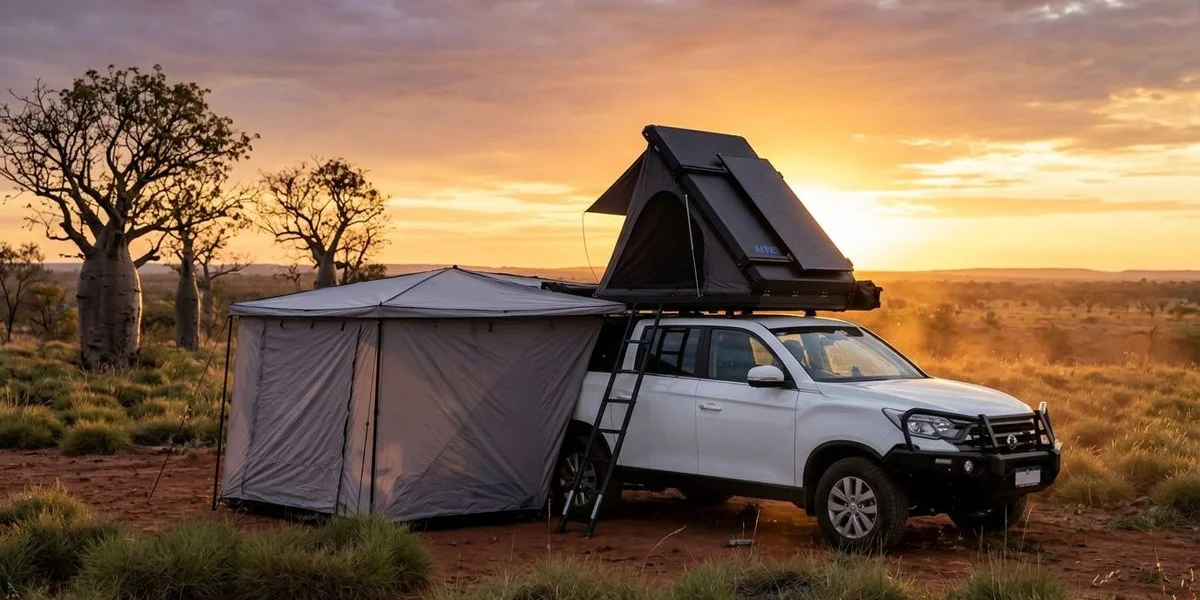
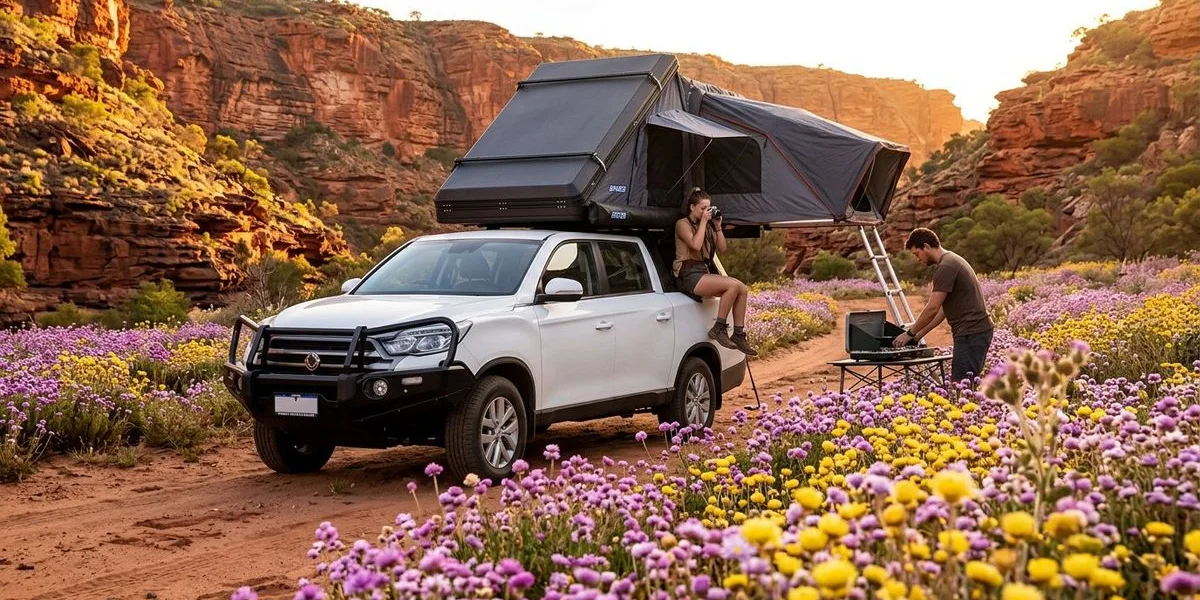
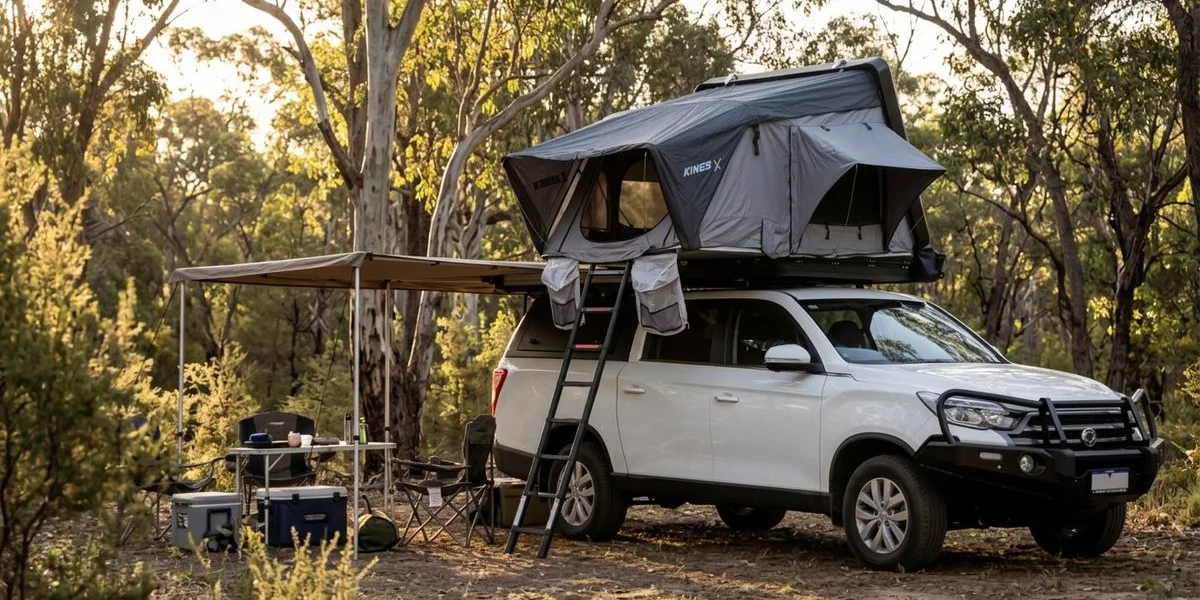
The outdoor side of a 4WD camper: A dual-cab 4WD camper with a rooftop tent is outdoor living, full stop. The kitchen sits under the awning, the dining room is camp chairs around a fold-out table, and you climb a ladder to bed.
In good weather, and WA hands you that most of the year, it is the better way to travel, because you are out in the landscape rather than watching it through glass.
The Coral Coast is dry and warm for eight months of the year, and even the South West’s wetter winter has plenty of clear days between fronts. The exception is the northern wet season, November to March, when the humidity and storms can make canvas camping hard work.
Manoeuvrability and Parking
A dual-cab ute has roughly the footprint of a large family car.
It slots into a standard 5.4-metre bay, handles the tight streets of Fremantle without drama, and turns around on a bush track without a spotter standing behind you.
I hear it often: someone hires a 7-metre motorhome, then spends half the holiday stressing about where to park it in towns like Margaret River or Exmouth.
Common Parking Pitfalls:
- Height Restrictions: Many beach car parks have height barriers to stop overnight camping, locking out tall motorhomes from day-use areas.
- Town Centres: In busy tourist hubs, you may have to park blocks away from the supermarket or café because your vehicle takes up two spaces.
- Campsite Sizes: Some older national park campgrounds have small, tight bays designed for tents or small trailers, making it impossible to park a large 6-berth rig.
Campsite Options and Fees
Motorhomes lean heavily on powered sites at caravan parks to run the air conditioning and top up their house batteries.
That dependence means $60 to $80 per night for a powered site in Exmouth or Coral Bay during peak season. It also pins you down to where the powered sites are, which is usually a row of vehicles that look exactly like yours.
The freedom of self-sufficiency: A self-contained 4WD camper runs off dual batteries, solar panels and portable gas.
It opens up WA’s network of Department of Biodiversity, Conservation and Attractions (DBCA) campgrounds, which is where I’d send anyone.
- Cost: usually $15 per adult, per night.
- Location: Right in the heart of nature (e.g., Osprey Bay in Cape Range or Dales Campground in Karijini).
- Booking: You can book these online via the “Park Stay WA” system up to 180 days in advance.
Being able to free camp, or use these low-cost national park campgrounds, cuts your accommodation bill hard, often more than $1,000 across a two-week trip, and it opens up an entirely different way to travel.
The Verdict for WA
For a Western Australia road trip, the dual-cab 4WD camper wins on nearly every practical measure: access, fuel, parking, campsite cost.
A motorhome makes sense in a few specific cases. Travelling with mobility limitations. Needing indoor living space for genuine medical reasons. Or planning to stay on sealed highways between major towns and nowhere else.
For everyone else, being able to turn off down a red dirt track and find a beach with nobody on it is the whole point of a WA road trip.
Still Deciding?
Not sure which one suits your plans? Send us your itinerary and we’ll talk it through.
You’ll get an honest answer, even if that means pointing you to a motorhome hire company because it’s the right call for your route.
Ready to Start Your Adventure?
Premium 4WD campers from $160/day. Depot pickup in Cloverdale, 5 minutes from Perth Airport.
Check Availability